
Nickel-Copper Nanowires
June 5, 2012 The well-known formula for the electrical resistance R of a wire contains a lot of useful information; viz.,R = ρL/Awhere ρ is the material resistivity, measured in ohm-meters, L is the length of the wire, and A is its cross-sectional area. A low resistance wire, which is what's needed in most applications, will be made from a low resistivity (high conductivity) material, will have a large cross-sectional area, and will be as short as possible.
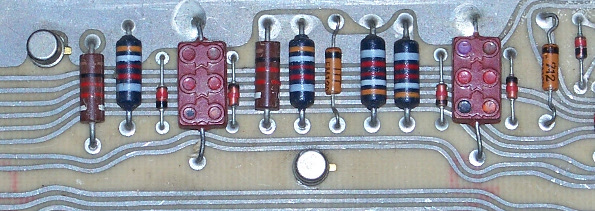 |
| Sometimes, your object is a high resistance, as provided by these resistors on a circuit board from a Univac 9200 Computer (c. 1966). Also shown are diodes (regular and zener), transistors (round objects), and some antique capacitors (rectangular objects). (Photo by the author.) |
| Copper Wire Properties |
| AWG | dia. (mm) | dia. (inch) | mΩ/m | mΩ/foot |
| 12 | 2.053 | 0.0808 | 5.211 | 1.588 |
| 14 | 1.628 | 0.0641 | 8.286 | 2.525 |
| Electrical Conductors (Data at 20°C from Wikipedia) |
| Material | ρ (10-8Ω-m) | Material | ρ (10-8Ω-m) | |
| Silver | 1.59 | Iron | 10 | |
| Copper | 1.68 | Platinum | 10.6 | |
| Gold | 2.44 | Tin | 10.9 | |
| Aluminium | 2.82 | 1010 Carbon steel | 14.3 | |
| Calcium | 3.36 | Lead | 22 | |
| Tungsten | 5.60 | Titanium | 42 | |
| Zinc | 5.90 | Stainless Steel † | 69 | |
| Nickel | 6.99 | Mercury | 98 | |
| Lithium | 9.28 | Nichrome | 110 |

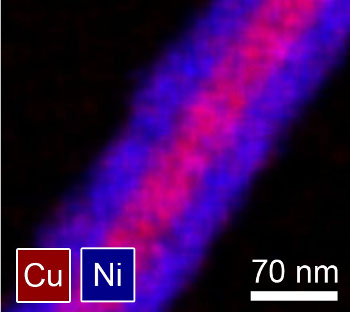 | Image of a nickel-coated copper nanowire. (Image supplied by Benjamin Wiley, used with permission). |
References:
- Ivo Jongsma, "Researchers find replacement for rare material indium tin oxide," Eindhoven University of Technology Press Release, April 11. 2011.
- Andriy V. Kyrylyuk, Marie Claire Hermant, Tanja Schilling, Bert Klumperman, Cor E. Koning and Paul van der Schoot, "Controlling electrical percolation in multicomponent carbon nanotube dispersions," Nature Nanotechnology (Published online April 10, 2011).
- Jennifer Marcus, "UCLA team develops highly efficient method for creating flexible, transparent electrodes," UCLA Press Release, November 21, 2011.
- Rui Zhu, Choong-Heui Chung, Kitty C. Cha, Wenbing Yang, Yue Bing Zheng, Huanping Zhou, Tze-Bin Song, Chun-Chao Chen, Paul S. Weiss, Gang Li and Yang Yang, "Fused Silver Nanowires with Metal Oxide Nanoparticles and Organic Polymers for Highly Transparent Conductors," ACS Nano (DOI: 10.1021/nn203576v), October 28, 2011.
- Ashley Yeager, "Copper-Nickel Nanowires Could Be Perfect Fit For Printable Electronics," Duke University Press Release, May 29, 2012.
- Aaron R Rathmell, Minh Nguyen, Miaofang Chi and Benjamin John Wiley, "Synthesis of Oxidation-Resistant Cupronickel Nanowires for Transparent Conducting Nanowire Networks," Nano Letters, Just Accepted Manuscript (May 29, 2012), DOI: 10.1021/nl301168r.
- Andriy V. Kyrylyuk, Marie Claire Hermant, Tanja Schilling, Bert Klumperman, Cor E. Koning and Paul van der Schoot, "Controlling electrical percolation in multicomponent carbon nanotube dispersions," Nature Nanotechnology (Published online April 10, 2011).