
Science Education
January 27, 2011 I wrote about the sorry state of US computer education in a recent article (K-12 Computer Education, December 8, 2010). In another article (Baking Soda and Vinegar, October 8, 2010), I reviewed last year's government report, "Rising Above the Gathering Storm, Revisited,"[1] that painted a bleak picture of US science education. Somehow, in the last few decades, the US decided it would emphasize brawn over brains by abandoning its pinnacle place as a technology and manufacturing powerhouse to become a de facto world police force. The consequences of this decision are apparent in the recently released 2009 National Assessment of Educational Progress[2] that shows that few students have the skills required for science and technology careers.[3-6] This survey, which is a report card for US education, assessed proficiency for 156,500 fourth-graders, 151,100 eighth-graders, and 11,100 twelfth-graders.[4] Just 34% of fourth-graders, 30% of eighth-graders, and 21% of twelfth-graders were deemed "proficient;" that is, demonstrating competency over challenging subject matter. Seventy-two percent of fourth-graders, 63% of eighth-graders, and 60% of twelfth-graders had a basic level of scientific knowledge. Coursework bears fruit, since twelfth-graders who took biology, chemistry and physics scored higher than students who didn't.[2] There was some state-to-state variation, with eighth-grade students in 15 states performing much lower than their nationwide peers.[2] North Dakota, South Dakota, New Hampshire and Massachusetts were the best in eighth-grade performance.[4] Just one or two percent at each grade level were considered to be at an "advanced" level (see figure).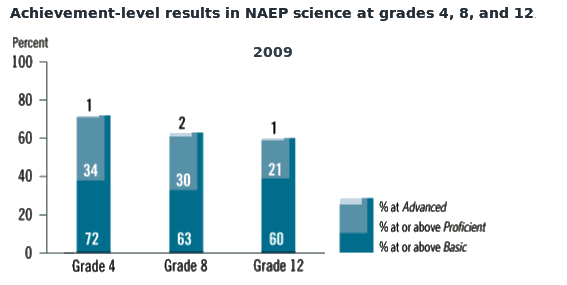 Source: U.S. Department of Education, Institute of Education Sciences, National Center for Education Statistics, National Assessment of Educational Progress (NAEP), 2009 Science Assessment.
As if to reinforce old stereotypes, the report found higher scores for male students, and for White and Asian/Pacific-Islander students.[2] At the twelfth-grade level, there were no significant differences between White and Asian/Pacific-Islander students. Both groups scored higher than other racial and ethnic groups. Boys scored higher than girls at all three grade levels.[2] Low-income students had the lowest scores, with students in cities scoring lower than those in suburban areas. Students in the Deep South did worse than those in the Northern and Northeastern states.[5]
Where should we place the blame? Some critics cite the 2001 No Child Left Behind Act, which emphasized reading and math, but not science. Said Francis Eberle, Executive Director of the National Science Teachers Association, "Science has been left off the national agenda for too long, and now we are paying the price... We are seeing a persistent degradation of skills, and we've lost a generation of students."[5] Bruce Alberts, a biochemist and past president of the National Academy of Sciences who is presently editor of Science, says that science teaching shouldn't be just memorizing words used by scientists. It must include learning about the critical thinking processes that scientists use.[3]
Alan Friedman, a physicist with The Museum Group and a member of the board for the National Assessment of Educational Progress, 2009 Science Assessment, points out that "Science isn't an isolated trade skill." Citizens need to assess their government's position on global warming, and farmers need to understand genetically engineered crops.[5] International student assessments have ranked US students thirteenth out of thirty-four developed countries in overall knowledge in a variety of areas. China, South Korea, Finland, Singapore, and Canada were at the head of the list.[6]
Now that these results are in the open, government officials can freely criticize No Child Left Behind and all the other failed programs. US Secretary of Education, Arne Duncan, had this to say in a prepared statement.
Source: U.S. Department of Education, Institute of Education Sciences, National Center for Education Statistics, National Assessment of Educational Progress (NAEP), 2009 Science Assessment.
As if to reinforce old stereotypes, the report found higher scores for male students, and for White and Asian/Pacific-Islander students.[2] At the twelfth-grade level, there were no significant differences between White and Asian/Pacific-Islander students. Both groups scored higher than other racial and ethnic groups. Boys scored higher than girls at all three grade levels.[2] Low-income students had the lowest scores, with students in cities scoring lower than those in suburban areas. Students in the Deep South did worse than those in the Northern and Northeastern states.[5]
Where should we place the blame? Some critics cite the 2001 No Child Left Behind Act, which emphasized reading and math, but not science. Said Francis Eberle, Executive Director of the National Science Teachers Association, "Science has been left off the national agenda for too long, and now we are paying the price... We are seeing a persistent degradation of skills, and we've lost a generation of students."[5] Bruce Alberts, a biochemist and past president of the National Academy of Sciences who is presently editor of Science, says that science teaching shouldn't be just memorizing words used by scientists. It must include learning about the critical thinking processes that scientists use.[3]
Alan Friedman, a physicist with The Museum Group and a member of the board for the National Assessment of Educational Progress, 2009 Science Assessment, points out that "Science isn't an isolated trade skill." Citizens need to assess their government's position on global warming, and farmers need to understand genetically engineered crops.[5] International student assessments have ranked US students thirteenth out of thirty-four developed countries in overall knowledge in a variety of areas. China, South Korea, Finland, Singapore, and Canada were at the head of the list.[6]
Now that these results are in the open, government officials can freely criticize No Child Left Behind and all the other failed programs. US Secretary of Education, Arne Duncan, had this to say in a prepared statement.
"The results released today show that our nation's students aren't learning at a rate that will maintain America's role as an international leader in the sciences... When only 1 or 2 percent of children score at the advanced levels on NAEP, the next generation will not be ready to be world-class inventors, doctors, and engineers."[5]In what may not have been coincidence, US President Barack Obama emphasized education and innovation in his State of the Union Address on Tuesday night (January 25, 2011) and warned that our failure to properly prepare students for careers in these fields is a threat to US prosperity.[7] Said Obama, "If we want innovation to produce jobs in America and not overseas, then we also have to win the race to educate our kids."[4] In 2009, the Obama administration launched a small ($260 million) program to train 10,000 new math and science teachers and invigorate classroom science programs.[5] I, for one, don't think the problem is with teachers. It's with the current educational philosophy that emphasizes testing and reporting over teaching - An approach that ensures jobs for administrators, but gives no benefit to our children. Perhaps there's change in the air. Obama called this education challenge our "Sputnik moment."[8] I was a child of our first Sputnik moment, and somehow I became one of the scientists the government had hoped to create.
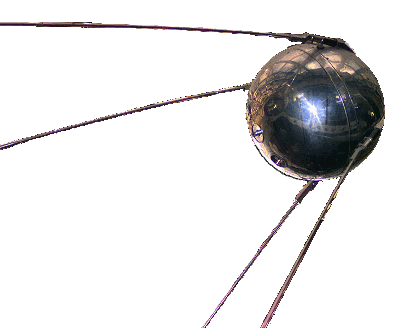 | Sputnik (NASA replica) |

References:
- Members of the 2005 "Rising Above the Gathering Storm" Committee, "Rising Above The Gathering Storm, Revisited," The National Academies Press, 2010.
- National Center for Education Statistics, "The Nation’s Report Card: Science 2009 (NCES 2011-451)," Institute of Education Sciences, U.S. Department of Education, Washington, D.C., 2011. Complete Report, PDF File
- Amanda Paulson, "'Report card' on science: Most US students aren't 'proficient'," Christian Science Monitor, January 25, 2011.
- Nick Anderson, "U.S. students falling short in science," Washington Post, January 26, 2011.
- Stephanie Banchero, "Students Score Poorly on Science Test," Wall Street Journal, January 26, 2011.
- Wendell Marsh, "American students do poorly in science, report says," Reuters, January 25, 2011.
- Amanda Paulson, "State of the Union mystery: What do Obama's Race to the Top plans mean?" Christian Science Monitor, January 26, 2011.
- Sam Gustin, "Obama’s Moon Shot: President Makes Tech Innovation a National Priority," Wired News, January 26, 2011.
- National Center for Education Statistics, "The Nation’s Report Card: Science 2009 (NCES 2011-451)," Institute of Education Sciences, U.S. Department of Education, Washington, D.C., 2011. Complete Report, PDF File