
Secure Labeling
April 12, 2011 In a previous article (Snowflakes, January 18, 2011), I wrote about how snowflakes are each unique in detectable ways. This principle is true for many natural and fabricated articles that appear identical under casual inspection. Even a glass of water is unique when examined isotopically.[1] What can be more identical than sheets of paper pulled one after the other from a ream? Close inspection under an optical microscope reveals that the fibers that compose these sheets are arranged differently. The tabula rasa is not really blank after all. A recently issued patent to Microsoft uses the microscopic uniqueness of paper as a means of ensuring the authenticity of a label.[2] The method can also be used to authenticate currency, bank and personal checks, and various forms of identification, such as driver's licenses and passports. Such labels can be used as an indication of product tampering when they seal access points. The idea is simple enough. You scan the paper on which the label is printed, and you use a technique to extract its uniqueness and represent it as a cryptographic key. As a crude example, you could designate thirty two locations on the label, and assign a data bit as a "1" or a "0" based on whether the fibers in the field of view are mostly oriented left-right, or up-down. In that way you can generate a 32-bit key that's printed on the label. As usual, the devil is in the details. First, it might be a close call as to whether those fibers are assigned to left-right, or up-down. Furthermore, the method of paper manufacture actually aligns fibers mostly in the "rolled" direction, so you'll get "1" more often than "O," or vice-versa, depending on how the labels are cut. The Microsoft inventors circumvent these problems by using paper that has chopped optical fibers embedded into it. Like the pulp fibers in ordinary paper, these optical fibers are distributed somewhat randomly, but they have the desirable feature that illuminating one end will produce a point of light at the other end. As shown in the figure, scanning a light source over the top half of a label will generate points of light at the bottom half. Subsequently scanning the lower half and identifying the points of light in the top half allows an identification of individual fibers, their apparent length and orientation.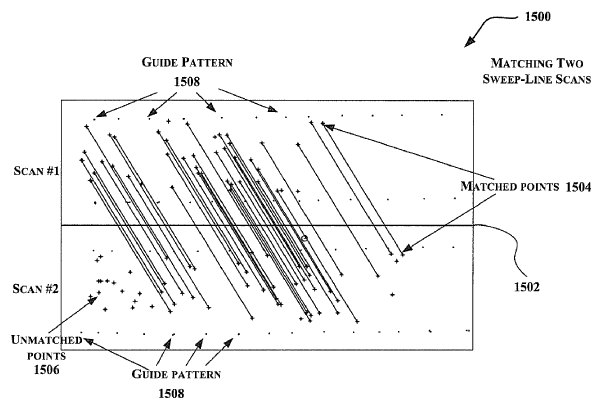 Method of locating individual optical fibers embedded in a label medium. Figure 15 of US Patent No. 7,878,398 [2]
Of course, not all of the optical fibers begin in one half of the label and terminate in the other. Some begin and terminate in one half or the other, but the scanning method selects just the subset of fibers that have one end in one half, and the other end in the other half.
Once you have the raw spatial data, it's easy, as they say, for "one skilled in the art," to generate any number of unique codes from the data. It's important that the codes are robust against the accidental breakage of some fibers during normal handling so there aren't too many false negatives. The patent throws a little math at the problem to illustrate one method.[2]
At the start of this article, I mentioned how the paper manufacture process causes a preferential orientation of fibers in one direction. This happens not just for paper, but for many materials. Metal sheets have different properties in the "rolled" and "transverse" directions, a property that's generally called texture.
Method of locating individual optical fibers embedded in a label medium. Figure 15 of US Patent No. 7,878,398 [2]
Of course, not all of the optical fibers begin in one half of the label and terminate in the other. Some begin and terminate in one half or the other, but the scanning method selects just the subset of fibers that have one end in one half, and the other end in the other half.
Once you have the raw spatial data, it's easy, as they say, for "one skilled in the art," to generate any number of unique codes from the data. It's important that the codes are robust against the accidental breakage of some fibers during normal handling so there aren't too many false negatives. The patent throws a little math at the problem to illustrate one method.[2]
At the start of this article, I mentioned how the paper manufacture process causes a preferential orientation of fibers in one direction. This happens not just for paper, but for many materials. Metal sheets have different properties in the "rolled" and "transverse" directions, a property that's generally called texture.
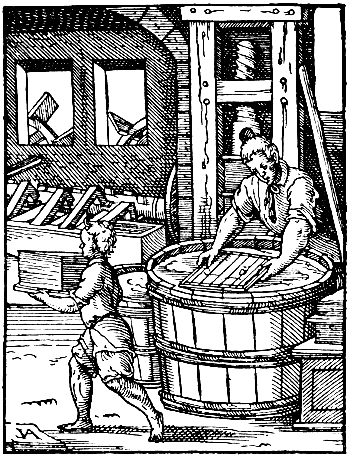 | Papermaking before mechanization. This type of paper would have the cellulose fibers distributed randomly, whereas fibers in machine-made papers have a preferred direction. Artisans still make paper by hand, today. [3] (Via Wikimedia Commons). |
