
A MEMS-FET Memory Cell
March 23, 2011 Before the advent of stored program computers, computers were programmed using plugboards. Programmers would connect wires from point to point on the computer to complete the necessary logic circuits for operation. The ENIAC is one such example. Later computers would have panel switches that would allow input of a simple boot program into memory. This program was usually a routine that would pass control to a punched-tape reader that would put a desired program into memory.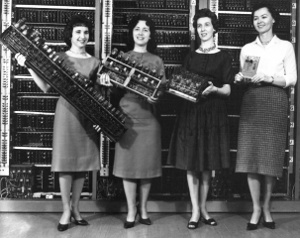 | 1960s glamor shot. A photograph showing the evolution of early computer circuitry. Left to Right: Patsy Simmers, holding ENIAC board; Mrs. Gail Taylor, holding EDVAC board; Mrs. Milly Beck, holding ORDVAC board; Mrs. Norma Stec, holding BRLESC-I board. (U.S. Army Photo No. 163-12-62, Via Wikimedia Commons. |

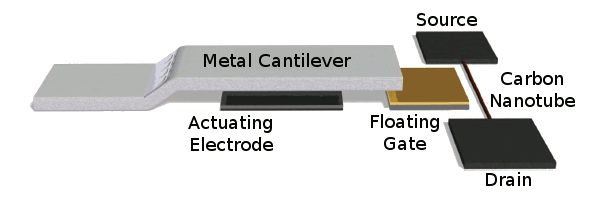 MEMS-FET memory element. The actuation electrode causes the MEMS cantilever to contact the carbon nanotube FET gate, which is built on a storage capacitor. Simplified image from ref. 1. Image licensed by the authors under the Creative Commons Attribution - NonCommercial - Share Alike 3.0 Unported License.
Carbon nanotubes have been proposed for a plethora of non-volatile memory architectures that have a variety of problems. These include slow speed and short data retention time. The mechanical switch approach solves both these problems, and it has the further advantages of extremely linear operation and low power operation. The actuator for the MEMS cantilever switch requires just 5 x 10-14 J.[2] The switching energy loss in a carbon nanotube FET is about the same as for a conventional FET, but the MEMS-FET architecture requires a much shorter switching time. The authors conclude that the power requirements for this memory cell is far less than for flash cell, which is anywhere from 20-1000 nJ.[2]
Flash memory can be reprogrammed anywhere from 10,000 to 100,000 times. MEMS cantilever switches of the type used in this memory device have demonstrated more than 100 million switching cycles. The switching time for the devices were found to be about 130 ns to switch to the "on" state, and 145 ns to switch to the "off" state. Because of the high linearity and high isolation of the switch, it was possible to program multinary states in the memory cells.[1]
MEMS-FET memory element. The actuation electrode causes the MEMS cantilever to contact the carbon nanotube FET gate, which is built on a storage capacitor. Simplified image from ref. 1. Image licensed by the authors under the Creative Commons Attribution - NonCommercial - Share Alike 3.0 Unported License.
Carbon nanotubes have been proposed for a plethora of non-volatile memory architectures that have a variety of problems. These include slow speed and short data retention time. The mechanical switch approach solves both these problems, and it has the further advantages of extremely linear operation and low power operation. The actuator for the MEMS cantilever switch requires just 5 x 10-14 J.[2] The switching energy loss in a carbon nanotube FET is about the same as for a conventional FET, but the MEMS-FET architecture requires a much shorter switching time. The authors conclude that the power requirements for this memory cell is far less than for flash cell, which is anywhere from 20-1000 nJ.[2]
Flash memory can be reprogrammed anywhere from 10,000 to 100,000 times. MEMS cantilever switches of the type used in this memory device have demonstrated more than 100 million switching cycles. The switching time for the devices were found to be about 130 ns to switch to the "on" state, and 145 ns to switch to the "off" state. Because of the high linearity and high isolation of the switch, it was possible to program multinary states in the memory cells.[1]